Turning green hydrogen into an attractive commercial product


Commercialisation of green hydrogen
The energy transition is also changing the energy system and therefore the energy market system that we know today. If green hydrogen is to be successful on the market, new hydrogen trading products must be developed in addition to an attractive regulatory framework. So far, however, the commercialisation of green hydrogen has hardly been tested. The consortium partner VNG AG is therefore working intensively with its subsidiary VNG Handel & Vertriebs GmbH as an associated partner to develop a viable business model for green hydrogen. With over 60 years of experience in the energy market and a broad and future-proof service portfolio in gas and infrastructure, the Group, which is active throughout Europe, is the ideal partner for this project. The business model to be developed should not only enable the green hydrogen produced in the Energiepark Bad Lauchstädt to be used by customers from 2026 and thus marketed in a way that covers costs as far as possible, but also serve as a guidepost for future developments in the hydrogen industry. It must therefore be proven that green hydrogen is not just technically but also economically feasible!

CONTACT PERSON
Sebastian Pflüger
Managing Director
Elektrolyse Mitteldeutschland GmbH
Senior Project Manager Hydrogen
VNG H&V

Utilisation of green hydrogen in the chemical industry
The green hydrogen produced at the Energiepark Bad Lauchstädt will be supplied entirely to the TotalEnergies refinery in Leuna, central Germany. As the main and sole customer, the refinery can use the hydrogen in its industrial processes, thereby replacing fossil hydrogen sources in the future. The green hydrogen is transported directly from the energy park to the refinery site via the approximately 25-kilometer-long repurposed gas pipeline.
In addition to its material use in the refinery, the energy park also demonstrates how green hydrogen can potentially serve as a link between renewable electricity generation and industrial energy demand – for example, through its storage capacity and system-friendly integration into an increasingly renewable energy system.
TotalEnergies as the first customer
The TotalEnergies refinery in Leuna, central Germany, is the official main customer for green hydrogen produced at the Energiepark Bad Lauchstädt. The first deliveries to the Total refinery in Leuna are scheduled for the second half of 2026.
Other areas of use for green hydrogen
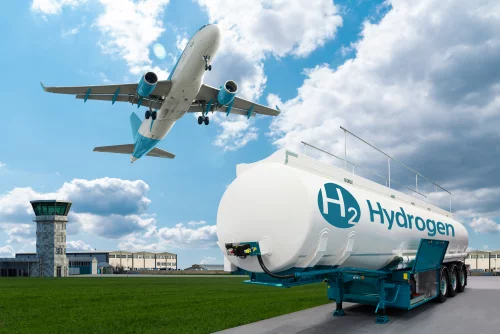
In the transport sector, green hydrogen primarily offers solutions for long range requirements such as shipping, air and long-distance road freight transport. In these sectors in particular, there is still no climate-friendly alternative to fossil fuels. The supercooled or compressed green hydrogen can either be tanked up directly or used as the basis for further processing into synthetic fuels. This is particularly relevant for shipping and aviation.
In the field of urban energy supply, the advantages of green hydrogen are primarily in closing potential supply gaps that can arise when using renewable energies due to periods in which there is no sunshine or wind. In order to close these supply gaps in the energy sector, the surplus energy generated in favourable phases can be stored in the form of hydrogen. If necessary, this energy can then be utilised in gas-fired power plants to bridge supply gaps and ensure a constant energy supply.
Hydrogen can also help to reduce CO2 emissions in the heating sector. By feeding it into the gas network, end customers can be supplied directly with a mixture of green hydrogen and natural gas. This concept is not new and has been used many times in the past. However, this will be the first time that green hydrogen has been used.