
Sustainable use of existing infrastructure for hydrogen storage & transport
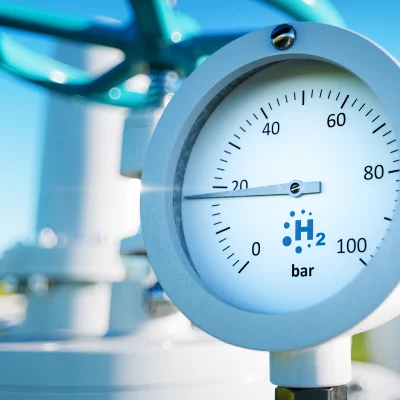

In order to close the gaps in the supply of the renewable energies in the future, new and innovative ways of storing the energy produced are needed. The world’s first underground storage facility for green hydrogen planned for the Energeipark Bad Lauchstädt represents a new milestone in this respect. The gas network connected to the Park also means we can transport the green hydrogen to the end customer in line with the general supply situation.
Calibrated gas volume measurement and future underground hydrogen storage
For the first phase of the real-world laboratory, above-ground plant components are planned that will connect a gas processing plant and a calibrated gas volume measurement system. These components will serve to integrate hydrogen into the existing infrastructure in a quality-assured manner and create the technical conditions for a possible future storage connection.
VNG Gasspeicher GmbH (VGS) has taken on the construction of the calibrated measuring rail. The measuring rail was completed in June 2025 and will in future measure how much hydrogen is actually produced and transmitted after electrolysis. It thus forms the basis for precise and legally compliant recording of the quantities of hydrogen produced.
Prospective use of existing infrastructure
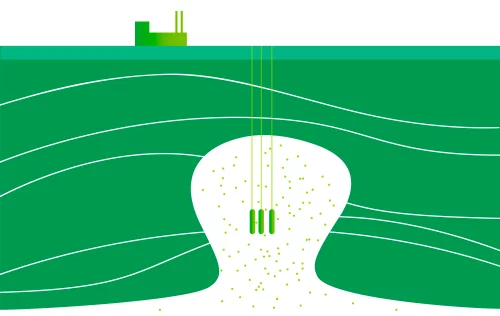
A follow-up project could involve the creation of an underground storage facility for green hydrogen. There are basically two options for underground gas storage: pore storage or cavern storage. While pore storage involves transporting the gas underground, where it is absorbed by the rock like a sponge, cavern storage involves artificially created cavities in the earth into which the gas is pumped. These are usually depleted natural gas reservoirs (porous storage) or old salt mines (cavern storage). In the case of the Energiepark Bad Lauchstädt, an existing natural gas cavern storage facility could be converted for the storage of green hydrogen.
Gas storage facilities are generally very safe. Accidents or incidents are impossible because there is neither oxygen nor ignition sources in the storage facility, which would be essential for dangerous incidents to occur. Accidents are therefore only possible in the above-ground pipeline system.

CONTACT PERSON
Kay Okon
Assetmanagment
VNG Gasspeicher GmbH
Transport of green hydrogen via a converted natural gas pipeline
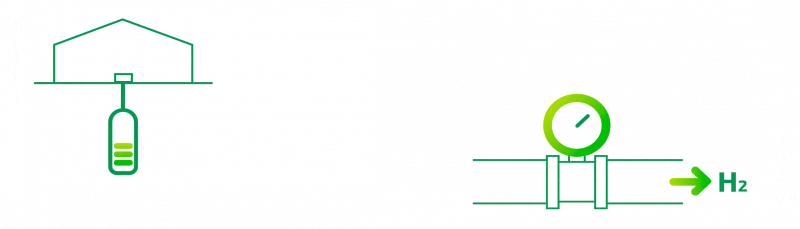
After conversion, green hydrogen can also be transported in existing steel pipelines that were formerly used for natural gas. The Bad Lauchstädt Energy Park therefore uses the existing gas network to transport the green hydrogen to the end customer. To this end, a 25-kilometre natural gas pipeline leading to the industrial area near Leuna was converted to transport pure hydrogen. In the future, it will also be possible to transport the green hydrogen produced at the Energiepark Bad Lauchstädt to other regions via connections to the organically growing infrastructure. For example, via the Green Octopus Central Germany (GO!) project, which has been classified as an Important Project of Common European Interest (IPCEI) Towards the west and the LHyVE sub-project, the hydrogen ring around Leipzig, towards the east. These links in the emerging European Hydrogen Backbone also provide access to import points and other hydrogen storage facilities.
The gas pipeline used for transport belongs to the network of the transmission system operator ONTRAS, which is responsible for both the conversion of the pipeline and its subsequent operation. ONTRAS operates the 7,700-kilometer pipeline network in eastern Germany and has been transporting green gases (biomethane, synthetic methane, and natural gas/hydrogen mixtures) for many years.
Before commissioning, the natural gas pipeline used for H2 transport was tested using state-of-the-art diagnostic tools to identify and eliminate any weak points. The pipeline was then separated from the natural gas system and integrated into the hydrogen infrastructure. This also included equipping it with suitable control, regulation, measurement, and monitoring systems to ensure safe operation at all times.
The hydrogen pipeline went into operation in April 2025 and is now operating at a pressure of 30 bar, although a maximum pressure of 63 bar would be possible. The decision not to use this maximum pressure reflects findings from the European Hydrogen Backbone, among others, which show that pipeline transport at medium pressure enables optimal operating conditions. Like all ONTRAS pipelines and facilities, this pipeline is also monitored and controlled 24/7 from the control center. The monitoring and maintenance cycles will be adapted to the new medium if necessary. Safety-relevant components (e.g., fittings and pressure control systems) can also be remotely controlled and can therefore be operated from the ONTRAS control center without any loss of time if necessary.

CONTACT PERSON
Christian Decker
Assetmanagement
ONTRAS Gastransport GmbH
Excellent hydrogen quality through gas treatment
Ensuring the highest purity standards is crucial for the effective utilisation of the hydrogen produced. During storage and transport, however, foreign substances can get into the hydrogen, which must be removed before it can be used. In order to provide customers with green hydrogen of the required quality and purity, specialised gas processing plants are required post-storage and post-transport.
The first gas processing station, which is being built on the premises of VNG Gasspeicher GmbH (VGS), will be constructed and operated by DBI - Gastechnologisches Institut gGmbH Freiberg (DBI). Because it is stored in a cavern, the green hydrogen may contain impurities such as water, oxygen or sulphur compounds, which can form in the cavern as a result of microbial activity. In order to remove these substances, the DBI is building plants for green hydrogen drying and desulphurisation on a 20 m x 30 m site. As part of the scientific support for the real-world laboratory of the energy transition, the DBI is investigating whether new – more efficient and cost-effective – processes can be developed for the preparation of hydrogen.
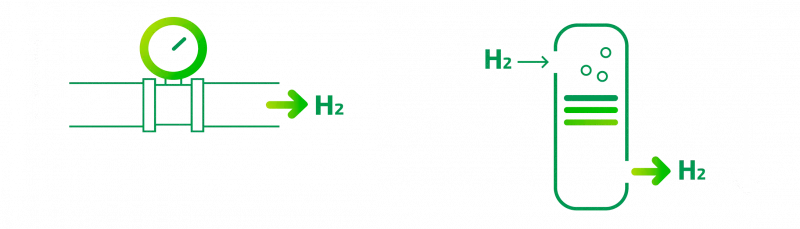
There is also a risk that green hydrogen through pipelines may be contaminated, for example by natural gas residues that adhere to the converted pipeline. In order to remove such contamination, special adsorbers with several layers (e.g. special activated carbon) are installed at the transfer station between the pipeline and the consumer. ONTRAS Gastransport GmbH will install and operate two such adsorbers at the transfer station to the refinery for the first anchor customer of the Energiepark Bad Lauchstädt, the TotalEnergies refinery in Leuna. The adsorbers each have a height of four metres and a diameter of approx. 1.5 metres.

CONTACT PERSON
Prof. Dr. Hartmut Krause
Managing Director Science & Education
DBI – Gastechnologisches Institut gGmbH