
Research at the Energiepark Bad Lauchstädt – How the DBI ensures the purity of hydrogen
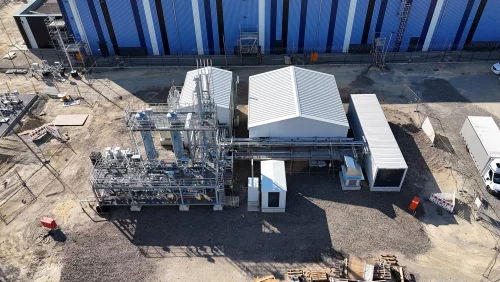
Green hydrogen is considered a key energy source of the future – but only if its quality is right can it be reliably used in sensitive applications such as fuel cells or chemical processes. This is precisely where the work of the DBI - Gastechnologisches Institut gGmbH Freiberg (DBI) in the Energiepark Bad Lauchstädt comes in. As part of the real-world laboratory, the company is constructing a hydrogen gas treatment plant to remove trace substances from the hydrogen. At the same time, DBI is developing analysis and testing methods that can be used to check and ensure the purity of the hydrogen produced along the entire value chain.
Why purity is crucial
Not all hydrogen is the same. Depending on the area of application – whether in the chemical industry, energy supply, or electromobility – different quality requirements apply. Even tiny traces of foreign substances in the range of a few millionths or billionths (ppm/ppb) can lead to malfunctions or efficiency losses in sensitive applications. In contrast, the purity requirements for hydrogen in combustion processes (e.g., in power plants) are significantly lower.
High-precision analysis during operation
DBI is constructing a gas processing plant at the Energiepark Bad Lauchstädt, where state-of-the-art methods for purifying and analyzing hydrogen will be tested in the future. Online sensors and gas chromatographs continuously monitor the purity of the H₂. In addition, samples are analyzed in DBI's accredited testing laboratory – depending on the issue at hand, using laser-based methods, mass spectrometry, or electrochemical and optical measurement technology.
The methods are based on international standards such as ISO 14687 (quality requirements) and ISO 21087-1 (measurement and testing methods) as well as the national regulations of the German Technical and Scientific Association for Gas and Water (DVGW e.V.). Depending on the application, the detection limits range down to the lower ppb range.
Purity testing as the key to cost-effectiveness
In addition to the technical challenge, cost-effectiveness also plays a role: hydrogen should be purified “as pure as necessary” – i.e., with as little energy and expense as possible, without compromising quality. DBI is therefore investigating how purity requirements, purification costs, and process stability can be optimally coordinated.
An important building block for the future of hydrogen
With its research into purity testing, DBI is making a key contribution to ensuring that green hydrogen can be used safely and economically on an industrial scale. The results from the Energiepark Bad Lauchstädt are not only being used to optimize local processes, but are also creating knowledge and standards for the entire industry – for a clean, reliable, and sustainable hydrogen economy in Germany and Europe. At the Leuna Chemical Park, H₂ users will be provided with very high-quality hydrogen, which will allow hydrogen to be used as a starting product for chemical syntheses.