
Energiepark Bad Lauchstädt – the future of green hydrogen
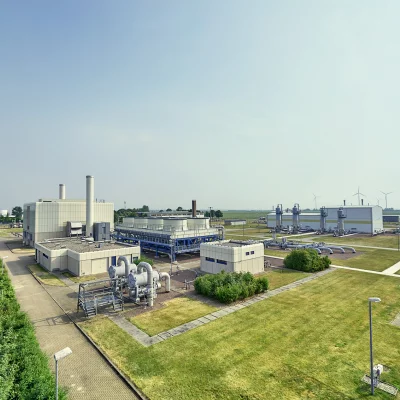

We produce, store, transport and supply the energy of tomorrow.
The success of the energy transition depends on renewable energies, energy-efficient solutions and, above all, long-term alternatives to fossil fuels. Green hydrogen has a key role to play here. In the innovative Energiepark Bad Lauchstädt project, the intelligent production of green hydrogen from wind power as well as its storage, transport, marketing and utilisation is being tested for the first time on an industrial scale in Central Germany. The Energiepark Bad Lauchstädt is therefore contributing to researching green H2 technology and bringing it to market maturity – for a technologically strong and future-oriented energy and hydrogen economy in Central Germany region and the successful integration of various energy sectors at national level.
News from the Energiepark Bad Lauchstädt
The Energiepark Bad Lauchstädt explained on film
Green hydrogen – modelling the entire process chain
For the first time in the world, the direct linkage of wind power from a nearby wind farm and a large-scale electrolysis plant with a capacity of up to 30 megawatts is being tested at the Energiepark Bad Lauchstädt – converting large parts of the wind power into green hydrogen on site. Temporarily stored in a salt cavern specially created for the purpose, the green hydrogen can be fed into the hydrogen network of the Central Germany chemical industry in via a converted gas pipeline and used in the future for industrial or urban mobility solutions.
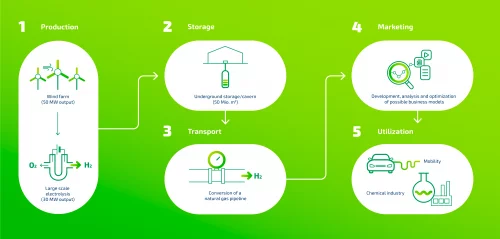


An accelerated energy transition and rapid expansion of renewable energies are essential for a secure energy supply and are more important today than ever before. We must consistently take the necessary steps to reach climate neutrality. A key aspect of this is hydrogen produced from renewable energies. At the Energiepark Bad Lauchstädt, the value chain from wind energy and hydrogen conversion to storage, transport and utilisation is being tested under production conditions. Such flagship projects show that the energy transition works on a large scale.
Dr. Robert Habeck
Former Federal Minister for Economics and Climate Protection